
AI Drives Markets to Record Highs Despite Iran War — Semiconductors Surge 30%
TSMC confirms no disruption to helium and sulfur supply chains — S&P 500 and Nasdaq post all-time highs for third consecutive session.
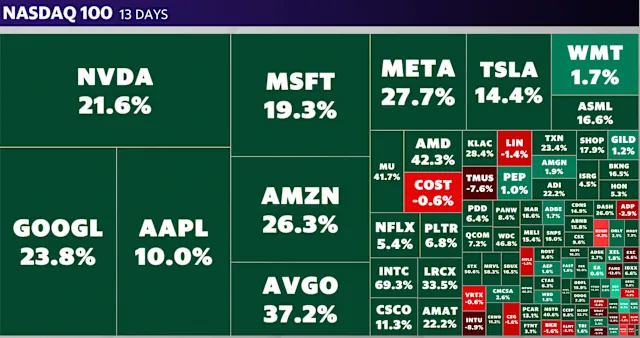
AI-driven tech stocks are pushing equity markets to all-time highs despite concerns over energy supply disruptions stemming from the Iran conflict. Growing market conviction that helium and sulfur supply uncertainties — ranging from natural gas to specialty industrial gases — cannot meaningfully derail earnings at semiconductor and Big Tech companies is fueling the rally.
The semiconductor ETF (SOXX) has surged more than 30% from its March 30 lows. Most members of the so-called 'Magnificent 7' — including NVDA, AMZN, GOOG, META, and TSLA — have posted double-digit gains. The technology software ETF (IGV) has also moved higher in tandem.
On the 17th (local time), Iran's Foreign Minister announced the full resumption of commercial vessel transit through the Strait of Hormuz, propelling markets to all-time highs for the third consecutive session. Oil prices plunged as much as 12%, with both Brent crude and WTI futures falling below $90 per barrel.
'Heavy Helium and Sulfur Users Can Comfortably Absorb Higher Costs'
At the core of this rally is the market's assessment that the robust profitability of Big Tech and semiconductor firms provides sufficient buffer to absorb rising raw material costs. Even if helium and sulfur supplies used in data center chip and server production face disruptions, high margins are seen as an effective shock absorber.
Morgan Stanley's Chief Asia Economist said in an interview this week, 'Companies that are heavy consumers of helium and sulfur are managing the elevated prices just fine for now.' He specifically referenced the South Korean and Taiwanese semiconductor industries, adding, 'These highly profitable companies are maintaining production lines even as gas, sulfur, and helium prices rise.'
TSM: 'Multi-Sourcing and Safety Inventory Ensure No Supply Disruption'
TSM, the world's largest contract chipmaker, stated during its Q1 earnings conference call that the likelihood of near-term operational disruption from the Iran conflict is low. The CFO noted, 'Specialty chemicals and gases, including helium and hydrogen, are sourced from multiple suppliers across different regions, and we maintain adequate safety inventory.' On energy supply, the company added that it is working closely with Taiwan's state utility and government to secure stable power.
Hyperscalers Shield Against Energy Costs With Long-Term Power Contracts
Wall Street is also taking note of the proactive steps major cloud and AI companies have taken to hedge against rising energy costs. By locking in electricity rates for the next 10 to 20 years through long-term renewable energy Power Purchase Agreements (PPAs), these firms have effectively minimized their exposure to oil price spikes.
In a recent report, Morgan Stanley stated, 'The AI-driven surge in power demand could accelerate the development of low-cost energy sources and technologies,' identifying AI power infrastructure, natural gas, nuclear energy, power grids, and energy storage and carbon solution companies as potential key beneficiaries.
📊 Related Stocks & ETFs
🧠 AI & Semiconductors
· NVIDIA (NASDAQ: NVDA)
· TSMC (NYSE: TSM)
· AMD (NASDAQ: AMD)
· Broadcom (NASDAQ: AVGO)
· Marvell (NASDAQ: MRVL)
· Intel (NASDAQ: INTC)
☁️ Big Tech & Hyperscalers
· Alphabet (NASDAQ: GOOG)
· Amazon (NASDAQ: AMZN)
· Meta (NASDAQ: META)
· Microsoft (NASDAQ: MSFT)
· Tesla (NASDAQ: TSLA)
⚡ AI Power Infrastructure
· NextEra Energy (NYSE: NEE)
· Constellation Energy (NASDAQ: CEG)
· Vistra (NYSE: VST)
· Entergy (NYSE: ETR)
· NuScale Power (NYSE: SMR)
· Oklo (NYSE: OKLO)
📈 ETFs
· iShares Semiconductor ETF (NASDAQ: SOXX) — Benchmark Semiconductor ETF
· iShares Expanded Tech-Software Sector ETF (NYSE: IGV)
· Invesco QQQ (NASDAQ: QQQ)
· Global X Robotics & AI (NASDAQ: BOTZ)
· First Trust NASDAQ Clean Edge Smart Grid (NASDAQ: GRID)
· Sprott Uranium Miners (NYSE: URNM)
Frequently Asked Questions
이란 전쟁에도 반도체가 30% 급등한 이유는?
빅테크와 반도체 기업의 높은 수익성이 헬륨·황 등 원자재 비용 상승을 흡수할 수 있다는 시장 판단입니다. 모건스탠리도 한국·대만 반도체 산업이 가스·황·헬륨 가격 상승을 충분히 감당하면서 생산을 유지하고 있다고 진단했습니다.
TSMC는 공급망 충격을 어떻게 막고 있나요?
1분기 콘퍼런스 콜에서 헬륨·수소 등 특수 화학물질을 여러 지역의 복수 공급업체로부터 조달하며 충분한 안전 재고를 확보했다고 밝혔습니다. 에너지도 대만 전력공사·정부와 긴밀히 협력해 안정적 전력을 확보 중이라고 못 박았습니다.
하이퍼스케일러는 에너지 비용을 어떻게 헤지했나요?
재생에너지 장기 전력구매계약(PPA)을 통해 향후 10~20년간의 전기요금을 고정해 두면서 유가 급등의 영향을 최소화했습니다. AI 전력 수요 급증은 저비용 에너지원과 기술 개발을 앞당길 수 있어 원자력·전력망·에너지 저장 관련 기업이 잠재 수혜주로 꼽힙니다.
이 랠리에서 가장 주목할 섹터는?
반도체(SOXX)와 기술 소프트웨어(IGV) ETF가 핵심이며, AI 전력 인프라 측면에서 NextEra·Constellation·Vistra·NuScale 등 전력·원자력 종목과 BOTZ·GRID·URNM 같은 인프라 ETF가 동반 수혜 대상으로 주목받습니다.

Zero SEC Earnings Filings Filed Aug 3 as AMD, SanDisk, Eli Lilly Earnings Loom; GE Vernova Misses Estimates
 MAR
MAR L
L TSN+12
Philippe Laffont's Q1 2026 Portfolio: TSM Stake Boosted, Full Exit from ORCL, SNOW, and 3 Others
 TSM
TSM GEV
GEV LRCX+7
No SEC Earnings Filings on Aug 2 — Tim Cook's Final Call, Big Tech Earnings Week Ahead
 AAPL
AAPL MSFT
MSFT AMD+2
AMD+2Wall Street's Defining Moments
See more
Sunday's SEC 8-K Earnings Filings Quiet, but Royal Gold Doubles Net Income and Launches Buyback
 RGLD
RGLDVeritone Earnings Shock Sends Shares Down 23%...York Space Systems Among 25 US Companies Filing SEC 8-K Earnings Reports
 YSS
YSS CODX
CODX IPWR+26
Applied Materials Posts Record Q3 Revenue of $9.1 Billion, All-Time High EPS
 AMAT
AMATSmart Money Briefing
Weekly summaries of Wall Street guru moves and crypto whale activity.