Two Years of Ridicule — Burry's Silence
In 2005, Michael Burry bet on the collapse of the U.S. housing market. All of Wall Street laughed. His investors revolted. After 27 months of losses, what he proved.

Two Years of Ridicule — Burry's Silence
1. 2 AM — What the One-Eyed Man Saw
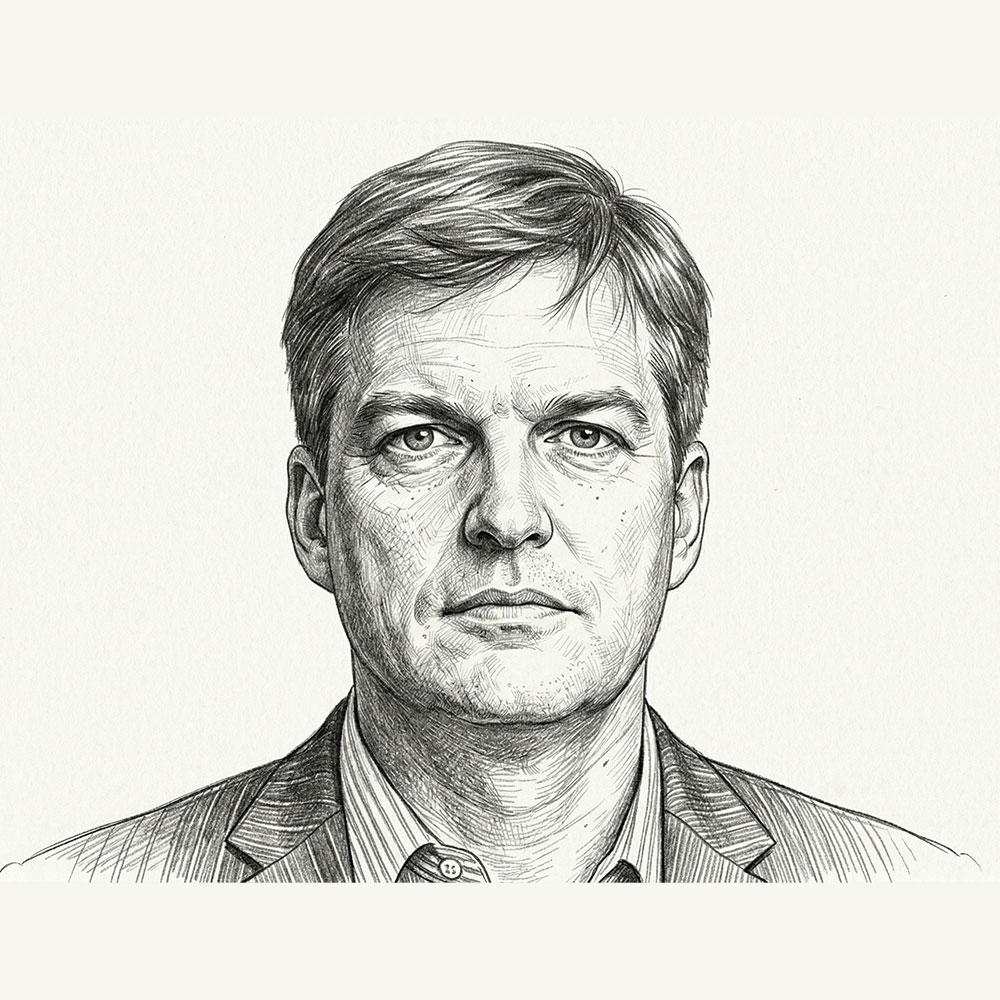
Fall 2005, an office in San Jose, California. Two in the morning. One fluorescent light on. Seven Diet Coke cans lined up on the desk. Metallica playing from the speakers. He was alone.
His left eye was prosthetic. He lost it at two years old to retinoblastoma. He had never been able to make proper eye contact with people his whole life — so instead of people, he watched numbers.
What he was reading that night was a 130-page prospectus. The terms governing American mortgage-backed bonds. Thousands of loans bundled inside, every borrower's amount and rate and repayment schedule printed in dense type. No one on Wall Street had ever read one to the end. Not even the credit rating agencies. They read the summaries, and the summaries said "AAA" — the same rating as U.S. Treasuries. The safest asset in the world.
Michael Burry read all 130 pages. And what he saw was simple. People who couldn't repay were being given money they couldn't repay.
He closed the laptop and leaned back in his chair. Stared at the ceiling for a long time. Then he decided: he would bet against the entire American financial system. From the other side.
2. "That Product Doesn't Exist"
May 2005. Burry called Goldman Sachs. "I want to buy credit default swaps on subprime mortgage bonds." A long silence on the other end. "…That product doesn't exist."
A reasonable response. No one had ever created insurance on falling home prices. U.S. home prices had never declined nationwide since the Great Depression. Selling that kind of insurance was like selling umbrellas in the desert — no one was supposed to want them.
Burry asked them to create it. Goldman obliged, bemused. Deutsche Bank obliged. Morgan Stanley obliged. Their logic was simple: Some lunatic wants to bet on this? Easy money standing on the other side.
By October, Scion Capital had accumulated $1 billion in CDS positions, with total notional exposure reaching $8 billion — thirteen times the fund's AUM. In return, Burry had to pay monthly premiums. Every month, until the bet paid off. The problem was that "every month" went on for 27 months.
3. The One-Eyed Crank
2006 arrived. U.S. home prices kept rising, and Scion's paper losses kept mounting. Monthly premiums had burned through over $100 million cumulative, and the fund's returns were cratering.
Investors exploded. Dozens of complaint letters arrived. "You're gambling with my retirement money." Some demanded redemptions, and had Scion not imposed a one-year lock-up, the fund would have collapsed on the spot. Lawsuit threats came in. An IRS audit came in. One of the largest investors publicly denounced him.
The strangest thing was something else. Subprime delinquency rates were clearly rising. Every week the data sided with him — yet CDS prices didn't move a dollar. The banks set the prices, and they were delaying marking losses onto their books.
When Burry demanded price updates, traders offered excuses. The person in charge called in sick today. There's a systems issue. Let's talk again next week. Once, a Goldman trader who said "we can't sell at that price" was caught selling to another hedge fund at that exact price the next day. A Wall Street trader called him "a one-eyed crank."
Burry closed his office door. He stopped talking to staff and just updated his spreadsheets every day. Mortgage delinquency data, default trends, pool maturity structures. The numbers were clearly on his side — the market alone refused to admit it.
It's 2006. You are Michael Burry. A year has passed since you built up $1 billion worth of CDS positions. You're bleeding millions in premiums every month, and mark-to-market losses are in the tens of millions. Your investors are furious. Lawsuit threats and an IRS audit have arrived. The data still supports your thesis. The market still hasn't moved. What do you do?
4. The Phones Started Ringing
Spring 2007. Cracks appeared. Some subprime bonds cracked, two hedge funds went bankrupt. Bear Stearns halted redemptions at its own hedge funds.
Then one day in July, Deutsche Bank called. "Mr. Burry. Those six CDS positions we sold you two years ago. We'd like to buy them back." A few days later Goldman called. The week after, other banks lined up. The market had flipped. The banks that had told him "that product doesn't exist" were now lining up saying "please sell them back."
Prices exploded. Positions that hadn't moved a dollar in two years were generating 30% weekly paper gains. Burry took profits on some and held the rest.
March 2008: Bear Stearns collapsed. September: Lehman Brothers went bankrupt. That same month, AIG received a government bailout. What he had predicted from data five years earlier unfolded exactly as he had foreseen.
5. 489.34%
From November 2000 to June 2008, Scion Capital's cumulative return net of fees was 489.34%. Over the same period, the S&P 500 rose about 3%. Scion outperformed the market by 162x. The single subprime bet delivered $725 million to investors; Burry's personal cut was $100 million.
Then he shut the fund down. Five years of war had exhausted him. The investor revolt, the IRS audit, the lawsuit threats, the public ridicule. At the very moment his thesis was proved right, he decided he would never again manage other people's money.
In April 2010, he wrote an op-ed for The New York Times. The title: "I Saw the Crisis Coming. Why Didn't the Fed?" The text was short and cold: "Anyone who studied the market carefully from 2003 to 2005 could have recognized this danger."
Once you've made your choice, reveal what the legend actually did
6. Three Things Burry Left Us
The subprime story is an American story. Its direct applications for Korean investors may seem limited. But the questions Burry's five years raise are valid regardless of market.
First, endurance is harder than analysis. Burry's real asset wasn't his analytical skill. It was endurance. Everyone knows the idea — "contrarian investing works" — but actually sitting through 27 months of losses while executing that idea is a completely different dimension. Korean retail investors routinely can't hold a single ETF through a 30% drawdown — with their own money. Burry held for 27 months getting verbally abused, with other people's money. This is why we can memorize Warren Buffett's words but never become Warren Buffett.
Second, the asset that has "never crashed" is the most dangerous. In 2005, U.S. housing was "the asset that hadn't declined nationally since the Great Depression" — and that consensus made everyone believe it was safe, which is exactly why it crashed. The more solidly an asset's safety is agreed upon, the greater the shock when that consensus breaks. If your portfolio contains an asset you assume is safe because "it has never crashed," examine that assumption itself. Safety priced into consensus is already in the price — and priced-in safety is no longer safety.
Third, credit ratings are consensus, not truth. Many of the bonds that collapsed in 2008 were rated AAA immediately before. The same limitation applies to ratings on ELS, DLS, and overseas bonds you invest in today. A rating doesn't guarantee safety. A rating is the consensus at that moment — and consensus can be wrong. Don't ignore ratings. Use them as a starting point for analysis, not as the conclusion.
7. Cassandra
In November 2025, Michael Burry deregistered Scion Asset Management with the SEC — meaning no more 13F filing obligations. That same month he posted one line on X: "On to much better things."
A few days later he launched a paid newsletter. Name: Cassandra Unchained. $379 per year. The first issue covered the positions he had been building throughout 2025: Nvidia, and Palantir. He called this the "AI bubble."
In Greek mythology, Cassandra was the prophet cursed to see the future accurately but never be believed. That Burry named his newsletter after her carries obvious intent. Whether he'll be right this time, no one knows. But what faces the people who mocked him in 2005 looked like in 2008 is on the record.
Sources
Michael Lewis, The Big Short (2010)
Scion Capital LLC, Investor Letters (2005–2008)
Burry, M., "I Saw the Crisis Coming. Why Didn't the Fed?", The New York Times (2010-04-03)
SEC Form 13F, Scion Asset Management (quarterly filings; deregistered November 2025)
Cassandra Unchained Newsletter (2025)
- 버리의 분석 시점
- 2005년 5월 (서브프라임 CDS 매수 시작)
- 시장이 인정한 시점
- 2007년 8월 (서브프라임 디폴트 본격화)
- 견딘 기간
- 27개월의 매월 수백만 달러 손실
- 환매 차단 도구
- 사이언 캐피털 1년 락업 조항
- 단일 펀드 최종 수익
- 7억 2,500만 달러 (489%)
- 핵심 교훈
- "분석을 끝낸 사람은 많다. 견딘 사람만이 가져간다."
What's your take on this story?
What do you think about Michael Burry's decision?
Sign in to participate
Sign InMichael Burry Today
Where is Michael Burry investing right now? See their latest 13F portfolio and current convictions.