The $500,000 Facebook Bet — The Greatest Investment in Silicon Valley History
June 2004. Peter Thiel, 37, handed a check to Mark Zuckerberg, 20, for $500,000. Eight years later, that check was worth over $1 billion — a return of roughly 2,000x. The result of a bet built on a single piece of advice: "Don't sell."
The $500,000 Facebook Bet — The Greatest Investment in Silicon Valley History
The Greatest Bet in Silicon Valley History — Inteliview Guru Story · Peter Thiel EP.2
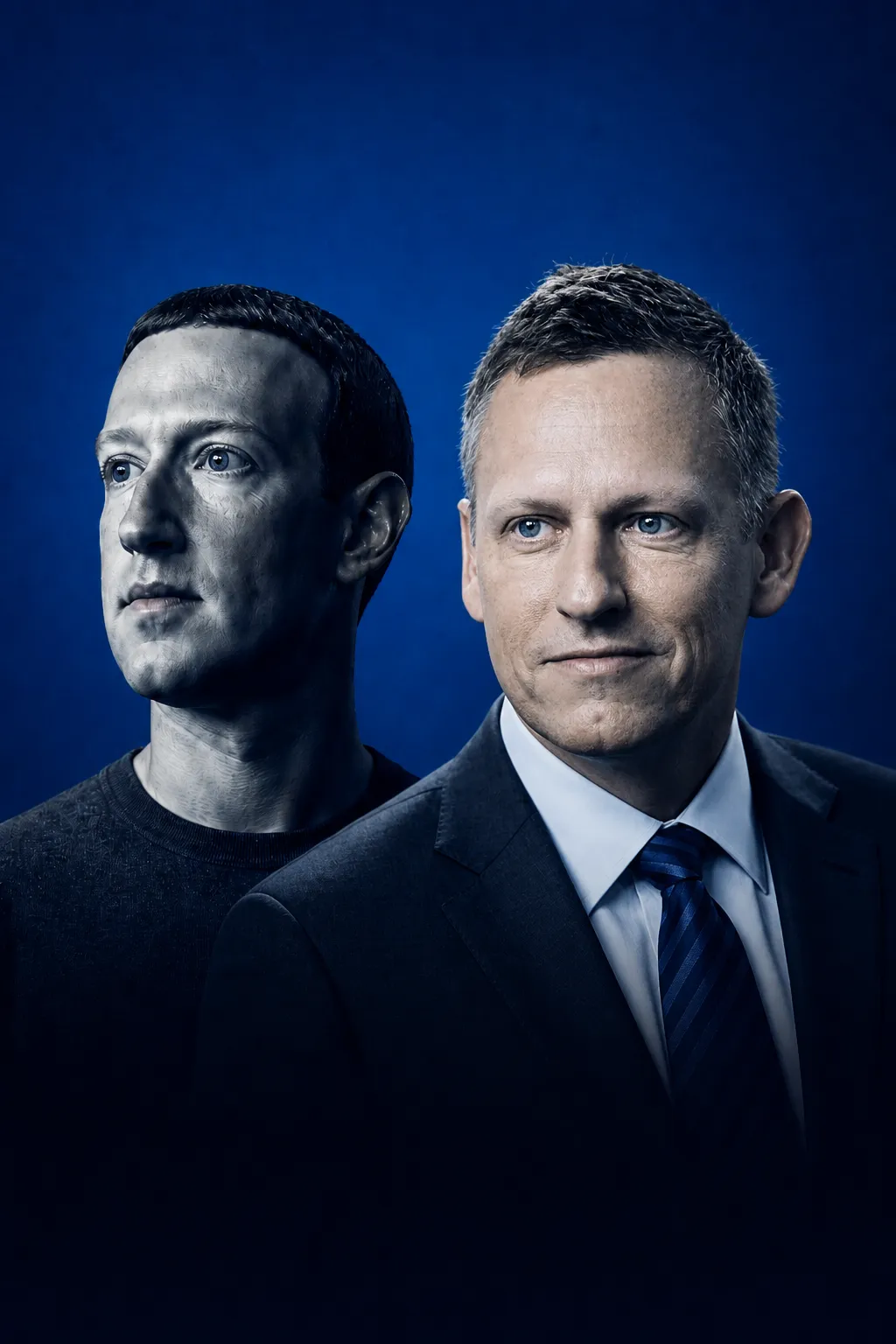
June 2004. A restaurant in San Francisco. Peter Thiel, 37, sat across from Mark Zuckerberg, 20. Zuckerberg was wearing a hoodie. He explained a website he had built at Harvard — a place where college students could view each other's profiles. There was no revenue model yet. Thiel listened, then pulled out a check. $500,000. This is the story of how that check became the most expensive $500,000 in investment history.
1. The Call from Sean Parker
In the spring of 2004, Thiel received a phone call. It was from Sean Parker.
Parker was Silicon Valley's enfant terrible. He had co-founded Napster at 19 and shaken the entire music industry to its core. Napster was eventually sued by record labels over illegal music sharing and shut down, but Parker's name had become legend in Silicon Valley. He later built a social network called Plaxo, only to be ousted by its board. His reputation: brilliantly talented, utterly uncontrollable.
Parker told Thiel:
Something huge just came out of Harvard. It's called TheFacebook. More than half of Harvard's students signed up — in a single month. The founder's name is Mark Zuckerberg. He's 20. Peter, you need to see this.
Thiel was intrigued, and for good reason. He had already seen the potential of social networks. The core engine behind PayPal's growth had been the "network effect" — the structure by which a service becomes more valuable as more people use it. Having experienced this firsthand at PayPal, Thiel was searching for where the next massive network effect would emerge.
Parker arranged a meeting.
2. The Kid in the Hoodie
June 2004. A restaurant in San Francisco.
Mark Zuckerberg walked in. Hoodie, jeans, sandals. Twenty years old. He had finished his sophomore year at Harvard and come to Silicon Valley for the summer.
Zuckerberg's presentation was anything but polished. No PowerPoint. He just opened his laptop and pulled up the site. TheFacebook.com.
What he described was simple: online profile pages for Harvard students. Real names only. Sign up with a school email. Only students from the same school could see each other. Launched at Harvard in February 2004, it had expanded to 30 universities — including Columbia, Stanford, and Yale — in just four months. About 200,000 users.
Thiel asked:
"Revenue?" / "None yet."
"Business model?" / "Haven't decided. We're focused on growth right now."
Investing in a college student's project with no revenue and no business model — in 2004, just four years after the dot-com bubble burst? Most investors would have walked out the door. Thiel saw it differently.
3. The Three Things Thiel Saw
As Zuckerberg spoke, three things stood out to Thiel.
First: The Purity of the Network Effect
At PayPal, Thiel had experienced the network effect firsthand — the structure by which a service grows more valuable as its user base expands. TheFacebook had an extraordinarily powerful version of it. The fact that more than half of Harvard's students had signed up meant the other half would inevitably follow. When all your friends are on it, opting out means being left out of the conversation. It wasn't really a choice — it was closer to compulsion. And this pattern was spreading from campus to campus. Once a school hit critical mass, it spilled over to the next one. Like a virus.
Second: Real-Name Identity
The other social networks of 2004 — MySpace, Friendster — were built on anonymity or screen names. TheFacebook required real names, verified through a school email address. This created two things: trust and identity. Because users were using their real names, they posted real photos and formed genuine relationships. It was a qualitatively different experience from anonymous social networks. Thiel grasped this intuitively: "The future of the internet isn't anonymous — it's real names."
Third: The Founder
Thiel's most important investment criterion: the founder.
Zuckerberg was 20 with no business experience. But Thiel saw one thing in him:
Mark said things that a typical 20-year-old doesn't say. Most young founders say, "I want to grow fast." Mark said, "I want to grow slowly, and do it right." He wasn't in a rush. The strategy was to completely dominate one school before moving to the next. That wasn't the patience of a 20-year-old. That was the patience of a monopolist.
4. $500,000
Thiel made his decision: he would invest. He negotiated the terms.
- Investment amount: $500,000
- Equity acquired: approximately 10.2%
- Pre-money valuation: approximately $4.9 million
He was putting $500,000 into a company valued at $4.9 million and walking away with 10.2%.
The investment came with one unusual condition: Thiel structured it as a convertible note — essentially a loan that could later be converted into equity. This was a favorable structure for the investor. If the company succeeded, he could convert to shares and hold equity; if it failed, he could recover his loan.
Along with the investment, Thiel joined TheFacebook's board of directors. A 37-year-old PayPal founder had taken a seat on the board of a 20-year-old's company.
What was the most important advice he gave at that board? Thiel later said:
The most important advice I gave Mark was simply: "Don't sell."
It's 2006. You are Peter Thiel — a Facebook board member. Yahoo has just offered to acquire the company for $1 billion. Your initial $500,000 investment is already worth tens of millions. The other board members want to sell. The social networking market is uncertain, and MySpace is still bigger. What do you do?
5. "Don't Sell"
As TheFacebook grew, acquisition offers began to arrive. Between 2004 and 2006, several companies made overtures. The most famous came from Yahoo!. In 2006, Yahoo offered to buy Facebook (by then rebranded from "TheFacebook") for $1 billion.
One billion dollars. A company valued at $4.9 million in 2004 was receiving a $1 billion offer just two years later. If Zuckerberg accepted, he would become a billionaire at 22.
Some of Facebook's other board members and investors urged him to take the deal. A billion dollars was enormous, the social networking market was still uncertain, and MySpace was bigger and more popular.
Thiel objected.
Don't sell. This isn't a billion-dollar company. This is a hundred-billion-dollar company.
Zuckerberg agreed. He turned down Yahoo's offer. There was pushback in the boardroom, but because Zuckerberg held a majority of the voting rights, the final decision was his.
The fact that Thiel had advised Zuckerberg on that very voting structure was itself a crucial decision. In a typical startup, each funding round dilutes the founder's equity and voting power. Thiel had recommended a dual-class share structure — one in which the founder's shares carry significantly more voting weight than ordinary shares. That structure is what made it possible for Zuckerberg to say no to Yahoo.
"Protecting the founder is the most important principle of investing." This was Thiel's conviction put into practice.
Once you've made your choice, reveal what the legend actually did
6. May 2012 — The IPO
Friday, May 18, 2012. Facebook went public on the Nasdaq.
IPO price: $38 per share. Market capitalization: approximately $104 billion. One of the largest tech IPOs in history.
What had become of Thiel's $500,000?
His original 10.2% stake had been diluted through multiple funding rounds over the years. But Thiel had also made additional investments, and by the time of the IPO, he held approximately 2.5% of the company. At a market cap of $104 billion, that translated to roughly $2.6 billion.
$500,000 → $2.6 billion. Approximately 5,200x.
Thiel's total investment in Facebook — the initial $500,000 plus any follow-on investments — was largely concentrated in that original check. Even accounting for additional capital, his total outlay amounted to a few million dollars. He put in a few million and walked away with $2.6 billion.
That said, Thiel didn't sell his entire position immediately after the IPO. Starting in August 2012, after the mandatory lock-up period expired, he sold his shares in stages. He held some of his position even longer.
In total, Thiel's estimated proceeds from his Facebook investment came to over $1 billion.
$500,000 → over $1 billion. Over 2,000x. In 8 years.
7. Why Didn't Other Investors See It?
In hindsight, Thiel's Facebook investment looks like an obvious success. But from where things stood in 2004, making this bet was anything but obvious.
First, the historical context. It was only four years after the dot-com bust. The entire category of "social networking" had yet to earn credibility. Friendster was already fading. MySpace was growing but its revenue model was murky.
Second, the founder's age. Twenty years old. Zero business experience. Most VCs preferred "seasoned CEOs." Handing money to a college student was considered reckless.
Third, no revenue model. Facebook had zero sales in 2004. It would take several more years for its advertising business to take shape. A company with users but no revenue was the very symbol of dot-com excess.
Other investors stumbled on all three of these obstacles. Thiel cleared all three.
How? He looked at it through a different lens. He didn't lump Facebook in with the failed social networks of the dot-com era. Instead, he focused on a qualitative distinction: the purity of its network effect and its real-name foundation.
And then there was the founder. Thiel saw Zuckerberg's age not as a weakness but as a strength. "A 20-year-old has nothing to lose. The person with nothing to lose is the most fearless."
- 소로스 — 영란은행 공매도
- 수십억 달러 동원 → 하루 10억 달러 수익
- 버리 — 서브프라임 CDS
- 수천만 달러 → 수억 달러 (2007-08)
- 애크먼 — 코로나 헤지
- 2,700만 달러 → 26억 달러 (100배)
- 린치 — 마젤란 13년
- 연 29% 복리 (꾸준함의 위대함)
- 틸 — 페이스북 시드
- 50만 달러 → 10억 달러 이상 (~2,000배)
- 시장 vs 사람
- 소로스/버리/애크먼은 시장에 베팅, 틸은 한 사람에 베팅
8. The Greatest Move of the Masters
When you compare the "greatest bets" of the legendary investors covered in the Guru Story series, the picture looks like this:
- Soros: Short on the Bank of England. Billions wagered → $1 billion profit in a single day.
- Burry: Subprime CDS. Tens of millions → hundreds of millions in profit.
- Ackman: COVID hedge. $27 million → $2.6 billion. 100x.
- Lynch: Magellan over 13 years. 29% annually. The power of consistency.
- Thiel: Facebook. $500,000 → over $1 billion. 2,000x.
By pure return, Thiel stands in a class of his own. 2,000x. It eclipses every other greatest bet on this list.
But there is one fundamental difference. The bets made by Soros, Burry, and Ackman were wagers on the direction of markets — "this market is going to collapse." Thiel's bet was on a single person: "this 20-year-old is going to change the world."
Markets can be analyzed with data. People cannot. Thiel's $500,000 came not from a spreadsheet, but from instinct and lived experience.
And the foundation of that instinct was PayPal. Thiel had experienced the network effect directly. He had worked alongside young geniuses firsthand. He had survived the dot-com collapse himself. Without that experience, he could never have written that check.
9. Three Lessons This Story Leaves Behind
First: The best investments happen earliest.
When Thiel put in $500,000, Facebook was valued at $4.9 million. At the IPO, it was worth $104 billion. Every investor who came after — Accel Partners ($12.7 million in 2005), Microsoft ($240 million in 2007) — made tremendous returns, but none could match Thiel's multiple. The person who took on the most risk, the earliest, was rewarded the most. How does this principle apply to individual investors in Korea? Rather than chasing a stock after its IPO, look before the IPO — before the crowd notices, when no one is paying attention.
Second: "Don't sell" is the hardest investment decision of all.
The most important thing Thiel did at Facebook wasn't making the investment — it was not selling. Turning down Yahoo's $1 billion offer. Not liquidating his entire position after the IPO. Most investors feel the pull to sell once they're in the money. A 10x return feels like the right time to exit. At 100x, selling feels almost obligatory. But the greatest returns in history went not to those who sold at 100x, but to those who held on to 1,000x. Jesse Livermore's words — "It was always my sitting" — apply just as powerfully here.
Third: Invest in people.
Thiel's Facebook investment was not a bet on a business model. In 2004, Facebook had no business model. It was a bet on a person named Mark Zuckerberg. What Thiel saw was a monopolist's patience, the fearlessness of someone with nothing to lose, and a strategic clarity far beyond his years. Just as Buffett evaluates the quality of management, Thiel evaluated the quality of the founder. If you're investing purely on financial statements and price charts, you may be missing the most important factor of all: who is leading that company, and do you believe in them?
10. The Weight of $500,000
One day in June 2004. A restaurant in San Francisco.
A 37-year-old man handed a check to a 20-year-old. $500,000.
What happened to that check?
The $500,000 paid for Facebook's first servers. It covered the first employees' salaries. It funded the move from Harvard to Silicon Valley.
And on top of that $500,000, two billion users were built. Hundreds of billions in advertising revenue were stacked. Instagram, WhatsApp, and Oculus were added.
When Thiel handed over that $500,000, he wasn't investing in a college student's website.
He was betting on a person.
And that bet paid off.
Next Episode Preview
〈Competition Is for Losers — Peter Thiel's Worldview〉
"Don't compete. Monopolize." Thiel's most controversial philosophy. Zero to One. Palantir and the CIA. The line between politics and investing. And "the truth that most people won't admit."
What's your take on this story?
What do you think about Peter Thiel's decision?
Sign in to participate
Sign InPeter Thiel Today
Where is Peter Thiel investing right now? See their latest 13F portfolio and current convictions.