
Amazon Swallows Globalstar for $11.57B — Satellite Spectrum War Targets Musk's Starlink Empire
Amazon has entered the D2D (Direct-to-Device) spectrum war with its $11.57 billion acquisition of satellite communications provider Globalstar (GSAT). As a three-way battle with Starlink and AST SpaceMobile intensifies, the deal is expected to trigger a broad revaluation of MSS spectrum assets held by players like Iridium and Viasat.
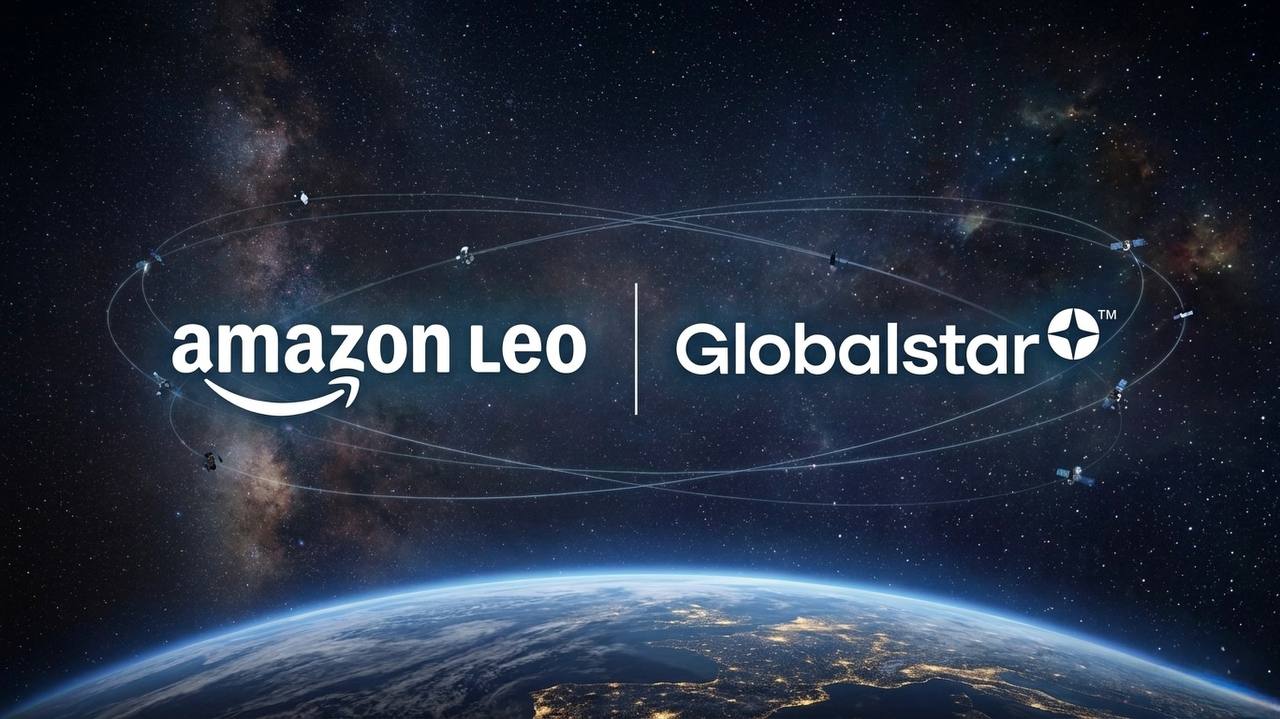
— The real play isn't closing a 9,759-satellite gap. It's the D2D spectrum.
Amazon has placed an $11.57B bet to acquire satellite communications provider Globalstar (Nasdaq: GSAT). On the surface, it looks like a move to bolster its satellite fleet against Elon Musk's Starlink — but industry analysts are unanimous in reading it as the opening shot of a spectrum war. The acquisition hands Amazon a card that could reshape the Direct-to-Device (D2D) market, where the company had been lagging behind ahead of a targeted 2028 commercial launch.
$11.57B Deal, $90 Per Share — A 117% Premium Megadeal
Amazon and Globalstar jointly announced on the 14th (local time) that they had signed a definitive merger agreement for Amazon to acquire Globalstar. The total deal value is approximately $11.57 billion, with Globalstar shareholders offered their choice of $90 cash per share or 0.3210 shares of Amazon common stock.
Globalstar shares surged more than 9% in pre-market trading following the announcement, on top of a roughly 6% gain over the prior two weeks driven by acquisition speculation. Amazon shares also rose approximately 1%. Globalstar's board has already secured written consent from 58% of shareholders, and the deal is expected to close next year, subject to regulatory approvals and Globalstar meeting certain satellite deployment milestones.
Fleet Count Still Lopsided — Starlink's 10,000+ vs. Amazon's 241
The numbers are stark. Starlink already operates more than 10,000 satellites, while Amazon Leo has launched just 2 prototype units and 241 production models. Even with Globalstar's 24 satellites added, the combined total reaches only around 265. Starlink's subscriber base of over 9 million further underscores how different the two operations are in scale.
Yet Wall Street and satellite industry analysts are calling this deal a "turning point in closing the gap" — for a specific reason. Armand Musey, Chairman of Summit Ridge Group, noted: "Amazon Leo has been trailing Starlink in satellite broadband, but the Globalstar acquisition allows it to catch up on D2D spectrum positioning and potentially pull ahead in D2D deployment."
The Real Target: MSS Spectrum — D2D Market Realigns Around Three Giants
The heart of this acquisition isn't the 24 satellites. What Amazon is really acquiring is Globalstar's satellite operating rights, infrastructure, and above all, its globally authorized Mobile Satellite Service (MSS) frequency licenses.
D2D technology enables satellites to communicate directly with standard smartphones without routing through ground base stations — widely regarded in the industry as a "game-changer for telecommunications." And that market had already been reframing itself around the race to secure MSS spectrum.
Competitor 1 — SpaceX: SpaceX acquired a $17 billion spectrum license from EchoStar last September. Analysts have long pointed out that "the PCS spectrum T-Mobile contributed to Starlink D2D represents only a small slice of terrestrial spectrum, and what SpaceX truly wants is the MSS spectrum held by players like EchoStar."
Competitor 2 — AST SpaceMobile: AST signed an agreement with Ligado Networks in March 2025 to secure up to 45MHz of mid-band spectrum across the U.S. and Canada on a long-term basis. AST recorded its first revenues of $70.9 million in 2025, marking its entry into early-stage commercialization.
Competitor 3 — Amazon Leo (new entrant): Louie DiPalma, analyst at William Blair, projected that "the approximately $11B acquisition price for Globalstar will lift the perceived value of MSS spectrum assets held by Iridium (NASDAQ: IRDM) and Viasat (NASDAQ: VSAT), and will push both AST SpaceMobile and SpaceX to pursue additional spectrum acquisitions to expand network capacity."
Apple's $1.5B Secret — Why It Stepped Back from Building Its Own Constellation
Another hidden protagonist in this deal is Apple. Apple had already invested approximately $1.5 billion in Globalstar and entered into a separate agreement with Amazon to ensure continued support for the satellite-based Emergency SOS and Find My safety features on iPhone and Apple Watch.
DiPalma's read is incisive: "Apple likely opposed funding a mega-constellation of its own to compete with SpaceX and AST SpaceMobile. This mirrors the pattern of Apple historically choosing partnerships over vertical integration in semiconductors and communications chips."
In effect, Apple's strategic calculus was to hand off the capital-intensive satellite business to Amazon while preserving service continuity and retaining its negotiating leverage.
FCC Deadline Looming — The Real Reason Amazon Moved Fast
A pressing regulatory deadline drove Amazon's urgency. The FCC has mandated that Amazon deploy 1,618 satellites — half of its full 3,236-unit constellation — by July 30, 2026, with the remainder required by July 30, 2029. With only 241 satellites currently in orbit, meeting that deadline in roughly three months is widely considered a physical impossibility.
Amazon filed for an extension of the first-generation constellation deployment deadline with the FCC in January 2026 and has publicly disclosed additional launch contracts covering 10 Falcon 9 and 12 New Glenn missions. Beyond ULA's Atlas V, Amazon has secured 22 additional launches in total — but industry consensus holds that reaching the 1,600-satellite mark within this year is realistically out of reach.
The Globalstar acquisition serves as a bridgehead to fill that gap. The FCC appears receptive. FCC Chairman Brendan Carr told CNBC: "Regulators have a very open posture toward this acquisition. It has the potential to make Amazon a genuine competitor to SpaceX in the direct-to-cell services space."
Amazon Leo's Counter — "6–8x Uplink, 2x Downlink"
Outgunned on satellite count, Amazon is competing on technical specifications. The company says Leo will deliver download speeds of up to 1Gbps — markedly higher than Starlink's typical range of 45–280Mbps. In his shareholder letter, CEO Andy Jassy claimed the hardware delivers "6–8x better uplink and 2x better downlink" performance compared to existing alternatives.
Enterprise customer wins are accumulating quickly. Amazon Leo has already signed up Delta Air Lines, AT&T, Vodafone, Australia's NBN (National Broadband Network), and NASA. Delta committed to equipping 500 aircraft with Leo service by 2028. Following the rebrand from Project Kuiper to Amazon Leo in November 2025, the enterprise beta launched officially on April 8, 2026, and CEO Jassy confirmed a mid-2026 commercial launch in his annual shareholder letter the following day.
'Space Internet' Market: Reshaping Into a Four-Way Race
The satellite communications market is now shaping up as a clear four-way contest: Starlink (10,000+ satellites, aggressive spectrum acquisition), Amazon Leo (241 satellites + acquisition strategy), AST SpaceMobile (specialized in direct-to-existing-handset connectivity), and regionally or state-led projects such as China's Guowang (GW) constellation and OneWeb.
For investors and businesses, three points stand out. First, companies holding MSS spectrum assets — including Iridium (NASDAQ: IRDM) and Viasat (NASDAQ: VSAT) — may be due for a significant asset revaluation. Second, if D2D technology reaches full commercialization, it will restructure roaming and remote-area coverage economics for traditional carriers, reshaping the strategic options available to SK Telecom, KT, and LG U+. Third, the Apple–Amazon–Globalstar triangle introduces a variable that could influence Samsung Electronics' own satellite connectivity partnership strategy.
Catching Starlink on sheer satellite volume is already considered "a near-impossible goal" by industry observers. But the D2D market is still in its infancy, and the outcome is more likely to be decided by spectrum holdings, partnerships, and regulatory approvals than by satellite count. Amazon's $11.57B is just the opening ante.
This content is provided for informational purposes only and does not constitute investment advice.
Frequently Asked Questions
아마존이 글로벌스타를 17조 원에 산 진짜 이유는?
위성 24기가 아니라 "글로벌 권한이 부여된 이동위성서비스(MSS) 주파수 라이선스"입니다. 스페이스X가 에코스타에서 170억 달러어치 스펙트럼을 인수한 것과 같은 D2D 시장의 핵심 자산이며, 윌리엄 블레어는 이 인수가 이리듐·비아샛의 MSS 자산 가치까지 끌어올릴 것으로 봤습니다.
FCC 마감이 왜 그렇게 급한가요?
FCC는 아마존이 2026년 7월 30일까지 3,236기 콘스텔레이션의 절반인 1,618기를 발사하도록 의무화했습니다. 현재 241기뿐이라 사실상 불가능한 시한이지만, 글로벌스타 인수가 이 공백을 메우는 교두보 역할을 합니다. FCC도 이번 인수에 호의적 입장입니다.
애플은 왜 자체 위성망 대신 아마존 인수를 선택했나요?
애플은 글로벌스타에 이미 15억 달러를 투자했고 아이폰의 Emergency SOS·Find My가 이 위성에 의존합니다. 윌리엄 블레어는 "애플이 메가 콘스텔레이션을 자체 자금으로 구축하는 것에 반대했을 가능성이 높다"고 분석했습니다. 위성 사업을 아마존에 넘기되 서비스 연속성과 협상 레버리지는 유지하는 패턴입니다.
아마존 레오의 차별화 카드는?
다운로드 속도 최대 1Gbps로 스타링크 일반 45~280Mbps 대비 현저히 높습니다. 재시 CEO는 "업링크 6~8배, 다운링크 2배 우수"라고 주장했습니다. 델타항공·AT&T·보다폰·호주 NBN·NASA를 이미 확보했고, 2026년 4월 8일 엔터프라이즈 베타 가동, 중반 상용 출시가 예정됐습니다.








Wall Street's Defining Moments
See more




Smart Money Briefing
Weekly summaries of Wall Street guru moves and crypto whale activity.