
IonQ Q1 Revenue $64.7M Beats Consensus by 30%; FY Guidance Raised to $270M
IonQ reported Q1 revenue of $64.7M, exceeding Wall Street consensus by 30%. The company raised full-year guidance to $270M but shares fell 6% after-hours amid technology skepticism and profit-taking.
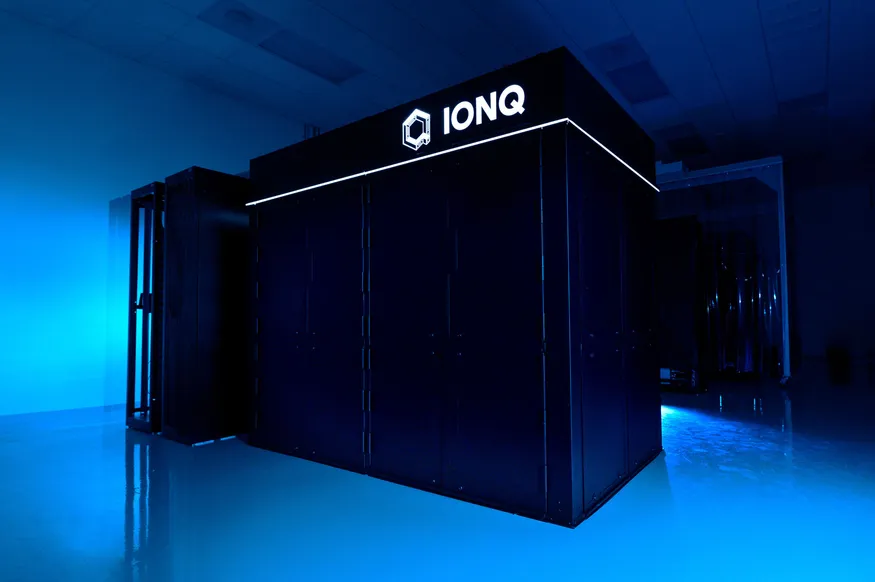
- IonQ beat Q1 consensus by 30% with $64.7M revenue and raised FY guidance to $270M
- Stock fell 6% after-hours despite strong results due to elevated pre-earnings expectations and profit-taking
Polymarket prediction proves accurate on earnings beat… yet after-hours decline of -6%, trapped-ion skepticism persists
All the figures from our earlier IonQ preview materialized—and then some.
IonQ reported Q1 2026 revenue of $64.7M after market close on the 6th (ET). This beat Wall Street consensus of $49.7M by over 30%. The Polymarket prediction of a 90% probability earnings beat proved spot-on.
Full-year guidance also received a substantial raise. The company lifted FY guidance from $225M–$245M to $260M–$270M, representing a 6%+ upside revision.
Despite these gains, the stock fell approximately 6% in after-hours trading.
Strong Results, Weak Stock Action — Why?
This mirrors the Palantir pattern we covered in our preview. Strong earnings don't always lift stock prices.
IonQ came into earnings with extremely elevated expectations. The month-long rally in the stock confirms this. Skepticism around the trapped-ion qubit technology pathway and its viability has persisted over several quarters
Alex Platt, D.A. Davidson
IonQ shares were already up 17% year-to-date heading into earnings. Strong results were delivered from an already elevated base. Rather than surprise, investors saw "as expected"—triggering profit-taking.
The CEO's Message: Growth Over Profitability in 2026
IonQ CEO Nicolò de Masi clarified the company's strategic posture in a Reuters interview.
Profitability is not a core objective this year. We are focused on revenue growth and expanding R&D investment to support that growth
Nicolò de Masi, CEO, IonQ
This defines IonQ's core investment dilemma. Revenue is scaling rapidly, yet EBITDA losses are widening to $310M–$330M. Today's buyer pays a growth premium on a loss-making company. Whether raised guidance justifies that premium is the crux of the investment thesis.
What Is Trapped-Ion Technology?
IonQ's technical approach warrants scrutiny. Trapped-ion involves manipulating charged atomic particles in a vacuum using lasers and electromagnetic fields. It is one of several qubit-creation methods and theoretically offers low error rates.
Scalability remains in doubt. As qubit counts grow, control becomes harder and errors accumulate. Google and IBM employ superconducting qubits instead. Which pathway wins remains uncertain. DA Davidson's reference to "technology skepticism" originates here.
Skywater, Lightlink, Capella — M&A Strategy Continues
Beyond earnings, IonQ's aggressive M&A strategy looms large. Acquisitions of Skywater Technology ($1.8B), Lightlink (quantum networking), and Capella (space-based quantum cryptography) aim to build a full-stack quantum platform.
Whether these acquisitions materially drive revenue growth will become clear over coming quarters.
Frequently Asked Questions
Why did the stock fall 6% after-hours despite beating earnings?
Similar to Palantir, IonQ priced in elevated expectations before the earnings release. Shares were already up 17% year-to-date and surged over the prior month. Market saw results as "as expected," triggering profit-taking rather than fresh upside surprise.
What is the difference between trapped-ion and superconducting qubits?
Trapped-ion directly manipulates atoms in vacuum, offering theoretically low error rates but facing scalability challenges. Superconducting qubits (Google, IBM) resemble semiconductor manufacturing, scale more easily but carry higher error rates. No clear technology winner has emerged.
Is the $270M full-year guidance realistic?
Q1 already delivered $64.7M; annualized that yields ~$259M. Raised guidance of $260M–$270M is within reach at current growth rates. Skywater acquisition completion remains a key variable.
Why is IonQ accepting widening EBITDA losses of $310M–$330M?
Quantum computing requires R&D investment ahead of revenue scale. CEO stated "profitability is not this year's priority—growth and R&D expansion are." EBITDA losses reflect strategic choice. Investors accept losses in exchange for growth premium.
How do the recent M&A deals—Skywater, Lightlink, Capella—affect the thesis?
These acquisitions target a full-stack quantum platform: Skywater ($1.8B) for chip fabrication, Lightlink for quantum networking, Capella for space quantum cryptography. Contribution to revenue growth will clarify the M&A strategy's ROI in coming quarters.



Wall Street's Defining Moments
See more



Sunday's SEC 8-K Earnings Filings Quiet, but Royal Gold Doubles Net Income and Launches Buyback
 RGLD
RGLDVeritone Earnings Shock Sends Shares Down 23%...York Space Systems Among 25 US Companies Filing SEC 8-K Earnings Reports
 YSS
YSS CODX
CODX IPWR+26
Applied Materials Posts Record Q3 Revenue of $9.1 Billion, All-Time High EPS
 AMAT
AMATSmart Money Briefing
Weekly summaries of Wall Street guru moves and crypto whale activity.